
Shots on Target Betting: What Counts and Shots vs SOT
Shots on target betting explained: what counts as a shot on target, why blocked shots don't, and how to choose between shots and SOT props using 2025/26 data.
- #shots-on-target
- #shots
- #player-props
- #settlement
- #strategy
Shots on target betting means backing a player to register a number of shots that would have scored without a save or a last-defender block. Blocked shots, misses and woodwork that stays out don’t count. In 2025/26, 35.1% of shots were on target and 74.7% of starters recorded none, so role and minutes matter more than recent form.
A shots market and a shots-on-target market on the same player are different bets. This guide covers what each one counts, where the difference costs bettors money, and how to research both using Fobal data from the 2025/26 season across the top five leagues, the Champions League and the Europa League.
35.1%
of shots were on target
Fobal, 2025/26, 53,180 shots
27.1%
of shot attempts were blocked
74.7%
of starters recorded zero shots on target
Fobal, 2025/26, 46,126 starts
50.2%
of forward starts had zero shots on target
What counts as a shot on target?
bet365, Sky Bet, Paddy Power and Betfair all settle player shots markets on Opta data, according to their published rules. The Opta definitions, as quoted in bet365’s statistics rules and Paddy Power’s football rules:
- Shot: any deliberate attempt on goal. It can go in, be saved, be blocked, miss, or hit the woodwork. Headers count.
- Shot on target: an attempt that goes in, would have gone in but for the goalkeeper’s save, or is stopped by the last defender when it was going in.
- Not on target: a shot blocked by any other outfield player, a miss, or a shot that hits the frame and stays out.
So every shot on target is also a shot, but not the other way round. Settlement detail, including what happens when your player is benched or the match goes to extra time, is in our guide to how player props are settled.
Animated pitch with five shots in turn: one blocked by an outfield defender (not on target), one dragged wide (not on target), one saved by the goalkeeper (on target), one scored (on target) and one cleared off the line by the last defender (on target).
Why do blocked shots matter so much?
Because they are common. In 2025/26, 27.1% of player shot attempts were blocked, against 34.6% on target and 38.2% off target. Every blocked shot helps a shots bet and does nothing for a shots-on-target bet.
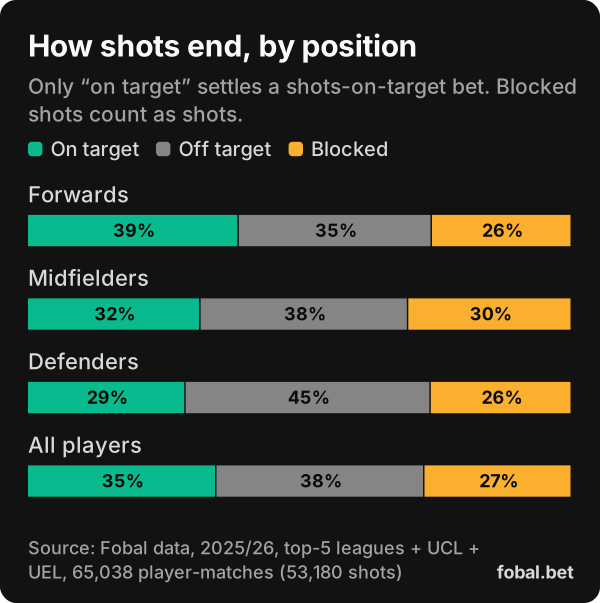
Midfielders suffer most. 30.1% of their attempts were blocked, and 31.3% for defensive midfielders, who mostly shoot from outside the box through a wall of bodies. A midfielder who “had four shots” may have put none of them on target without being unlucky. That is simply where he shoots from.
Shots or shots on target: which market fits the player?
| Market | Shots | Shots on target |
|---|---|---|
| Counts blocked shots | Yes | No (except last-man blocks) |
| Counts misses and woodwork | Yes | No |
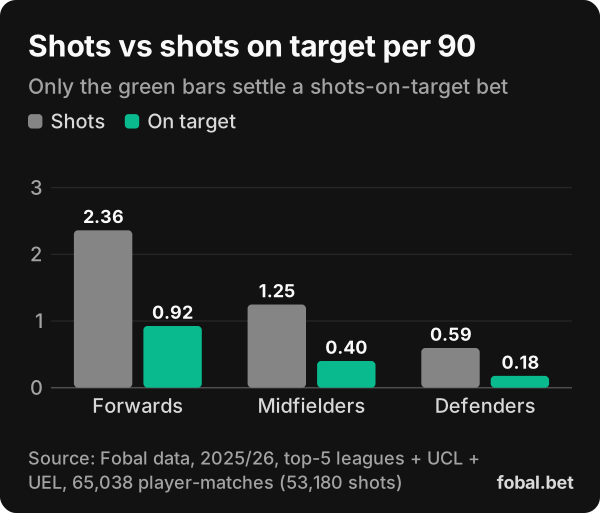
| Forwards per 90 | 2.36 | 0.92 |
| Midfielders per 90 | 1.25 | 0.40 |
| Starters with zero | 48.9% | 74.7% |
| Forward starts with zero | 20.1% | 50.2% |
| Suits | Volume shooters, long-range midfielders, set-piece takers | Central strikers who shoot from close range |
| Main risk | A quiet match with few touches | Blocks and misses, even when he shoots |
Source: Fobal data, 2025/26, top-5 leagues + UCL + UEL. Per-90 figures use all minutes; “zero” rows use starts only.
The shots market measures how often a player pulls the trigger, and the shots-on-target market adds how well. For a box striker, the two move together. For a midfielder who shoots from 25 yards, they come apart, and only the shots market reflects his involvement.
Which positions hit the target most often?
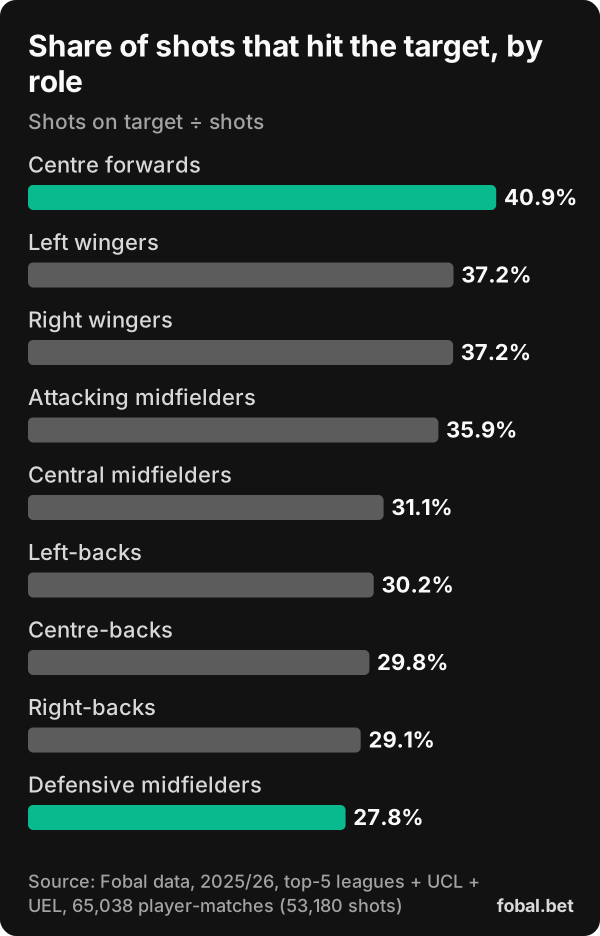
Centre forwards turn 40.9% of their shots into shots on target. Defensive midfielders manage 27.8%. By broad group, forwards hit the target with 39.2% of their shots, midfielders 32.1% and defenders 29.6%.
That ratio is a useful filter. A centre forward needs about 2.5 shots for each shot on target, a defensive midfielder about 3.6. When a midfielder’s shots line looks tempting, his shots-on-target line rarely is.
How often do players actually get one?
Less often than most bettors assume.
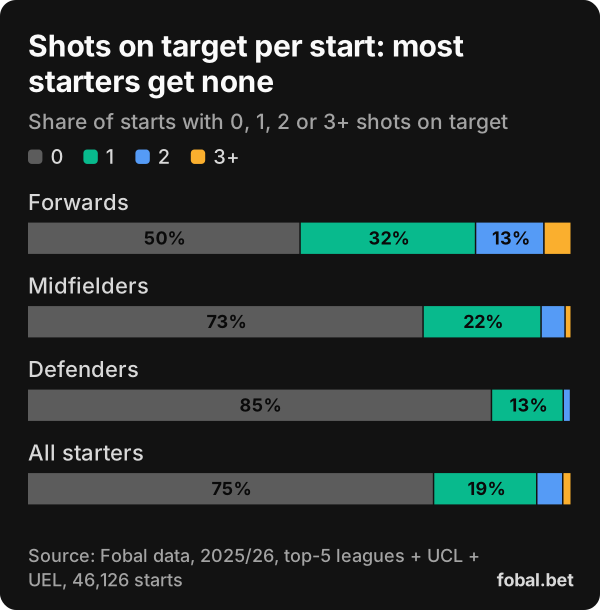
- 74.7% of starters recorded zero shots on target, 19.0% exactly one, 4.8% two and 1.6% three or more.
- Forwards drew a blank in 50.2% of starts. 17.6% of forward starts reached two or more.
- Midfielders reached two or more in only 5.6% of starts.
So over 1.5 shots on target is a bet on something that happens in fewer than one in five forward starts. That is fine when the price reflects it, but it should be a deliberate choice, not a default.
From base rate to price: a worked example
A base rate becomes useful once you turn it into a break-even price. Decimal odds of 1 ÷ probability are the break-even point, before any bookmaker margin.
- An average forward start produced 1+ shot on target 49.8% of the time. Break-even for over 0.5 is about 2.01.
- The same average forward reached 2+ in 17.6% of starts. Break-even for over 1.5 is about 5.68.
- Harry Kane landed 1+ in 91.9% of his starts. Break-even for his over 0.5 is about 1.09.
The useful habit is the direction of the check. Start from how often the event really happens, then ask whether the price beats it. Starting from the price and looking for reasons to back it gets this the wrong way round.
Who takes the most shots on target?
Players with at least 1,800 minutes in 2025/26, all seven competitions combined. We use a high minutes threshold on purpose. Lower thresholds fill the list with substitutes whose per-90 rates rest on a few minutes.
| Player | Club | SOT per 90 | Shots on target | 1+ SOT in starts |
|---|---|---|---|---|
| Harry Kane | Bayern Munich | 2.42 | 55.8% | 91.9% |
| Kylian Mbappé | Real Madrid | 2.39 | 46.2% | 89.5% |
| Erling Haaland | Manchester City | 1.91 | 49.1% | 83.7% |
| Mason Greenwood | Marseille | 1.83 | 43.0% | 86.5% |
| Michael Olise | Bayern Munich | 1.83 | 47.3% | 85.7% |
| Rafa Mir | Elche | 1.79 | 51.4% | 95.2% |
| Deniz Undav | VfB Stuttgart | 1.76 | 39.1% | 73.5% |
| Alexander Sørloth | Atlético Madrid | 1.73 | 51.0% | 72.0% |
| Ferran Torres | Barcelona | 1.72 | 51.8% | 65.4% |
| Donyell Malen | Roma / Aston Villa | 1.71 | 44.1% | 78.6% |
| Lautaro Martínez | Inter | 1.71 | 42.2% | 75.8% |
| Robert Lewandowski | Barcelona | 1.68 | 47.7% | 66.7% |
| Nikola Krstović | Atalanta | 1.68 | 35.5% | 73.9% |
| Khvicha Kvaratskhelia | Paris Saint-Germain | 1.67 | 41.2% | 67.7% |
| Marcus Rashford | Barcelona | 1.60 | 37.7% | 77.3% |
Source: Fobal data, 2025/26, top-5 leagues + UCL + UEL, 1,000 players with 1,800+ minutes. “Shots on target” = share of his shots on target.
Two things stand out. Per-90 rate and hit rate in starts do not line up neatly. Ferran Torres shot on target at 1.72 per 90 but landed one in only 65.4% of his 26 starts. Sixteen of his 42 appearances came off the bench, and a per-90 rate counts those minutes too. And Rafa Mir’s 95.2% comes from 21 starts, which is a small sample. Our piece on why “hit in 8 of the last 10” can mislead you explains why such numbers drift back.
What drives a player’s shots on target?
- Role. Where he shoots from sets his accuracy, as the role chart above shows. A winger moved to striker changes both his volume and his ratio.
- Minutes. A per-90 rate means little if he is substituted on 65 minutes. Multiply the rate by the minutes you expect, as our guide to expected minutes shows.
- Team dominance. A side that camps in the opposition half creates more shots for its forwards. The same striker faces a different match against a low block than in an open game.
- Set pieces and penalties. Headed attempts count as shots. A scored or saved penalty is a shot on target, and a missed one is not, so the designated taker carries an extra chance in some matches.
- Competition. In 2025/26, 38.2% of shots were on target in the Champions League against 32.7% in Serie A. Our league comparison has the full breakdown.
Shots on target research checklist
- Confirm the line-up. Check the start and the likely minutes before anything else.
- Check the role, not the position label. A nominal winger who plays as a second striker shoots like a forward.
- Look at the shots-to-target ratio. If most of his efforts are blocked or off target, the shots market may fit him better.
- Read his per-90 rate over a full season and set it against starts, not total appearances.
- Check how often he lands one in his starts. The table above shows how far this can sit from the per-90 rate.
- Factor in the opponent and match state. Will his team have the ball?
- Check penalty duty and who takes direct free kicks.
- Read your bookmaker’s rules for non-starters and extra time.
On Fobal’s player pages, each market is charted match by match with the minutes under every bar, so you can see whether a strong run came from full matches or from cameos.
Common mistakes in shots on target betting
- Counting blocked shots as near misses. They are not on target and never were. With 27.1% of attempts blocked, this is the most common misreading.
- Trusting a hot streak. A 10-match run is noisy, and it is noisier still for lines above 0.5. Read it against the full-season rate.
- Ignoring the zero. Even forwards fail to register a shot on target in half their starts. A forward on over 0.5 is roughly a coin flip before you look at the player.
- Using a lenient threshold for “best shooters” lists. A substitute with 900 minutes can top a per-90 table on volume he will never reach as a starter.
- Mixing up the markets in a bet builder. “Two shots” and “two shots on target” are very different events for a midfielder.
None of this makes any shots-on-target bet a sure thing. These are high-variance markets where one block or one save changes the result. Our beginner’s guide to player props covers the other markets, and our responsible betting guide covers staking and limits.
Frequently asked questions
What counts as a shot on target in betting?
Under the Opta definition used by bet365, Sky Bet, Paddy Power and Betfair, a shot on target is a deliberate attempt that scores, is saved by the goalkeeper, or is blocked by the last defender when it was going in. Shots blocked by other outfield players, shots that miss and shots that hit the woodwork and stay out are not on target.
Does a blocked shot count as a shot on target?
Usually not. A shot blocked by an outfield defender with other players or the goalkeeper behind him counts as a shot but not as a shot on target. The exception is a block by the last defender, for example a clearance off the line, which counts as on target. In 2025/26, 27.1% of player shot attempts were blocked.
Does hitting the post count as a shot on target?
No, unless the ball goes in. Opta classes a shot that hits the frame of the goal and stays out as off target.
Does a penalty count as a shot on target?
A penalty that is scored or saved is on target, because goals and saves both count. A penalty that misses or hits the post and stays out is not. Check your bookmaker’s rules for retaken penalties.
Is it better to bet on shots or shots on target?
Neither is better in general. Shots suit high-volume players whose efforts are often blocked or off target, and shots on target suit accurate central forwards. In 2025/26 forwards averaged 2.36 shots and 0.92 shots on target per 90, and half of all forward starts produced no shot on target.
Who has the most shots on target per 90?
Among players with at least 1,800 minutes in 2025/26 across the top five leagues, the Champions League and the Europa League, Harry Kane led with 2.42 shots on target per 90, ahead of Kylian Mbappé on 2.39 and Erling Haaland on 1.91.