
Responsible Betting for Player Prop Bettors
Responsible betting for player props: why props feel controllable, what bet builder margins cost, how to set limits and staking units, and where to get help.
- #responsible-betting
- #safer-gambling
- #bet-builders
- #staking
- #limits
Answer first: responsible betting on player props means betting only money you can afford to lose, deciding your stakes and limits before you start, and keeping a record. Props reward research, which makes them feel controllable, but single matches are noisy and bet builders carry large margins. If betting stops being fun, free help is available.
74.7%
of starters record no shot on target in a match
Fobal, 2025/26, 7 comps
20–35%
average bet builder margins across UK bookmakers
SBC News / Propus, Jan 2024
1 in 6
chance a genuine 60% player shows 8+ hits in 10 by luck (maths)
0808 8020 133
National Gambling Helpline (GamCare), free, 24/7
This guide is for people who enjoy betting on player props and want to keep it that way. It is practical, not a lecture: how the products work against you, how to set limits that hold, and where to go if things go wrong.
Why do player props feel more controllable than they are?
Player props reward homework. You can study a striker’s shots, a midfielder’s fouls or a full-back’s opponent, and the research feels like control. Psychologists call the trap the illusion of control: expecting a better chance of success than the objective odds justify. Ellen Langer described it in her classic 1975 paper in the Journal of Personality and Social Psychology, and it has been a building block of gambling research since.
Research does improve your estimate. It does not remove the noise in a single match:
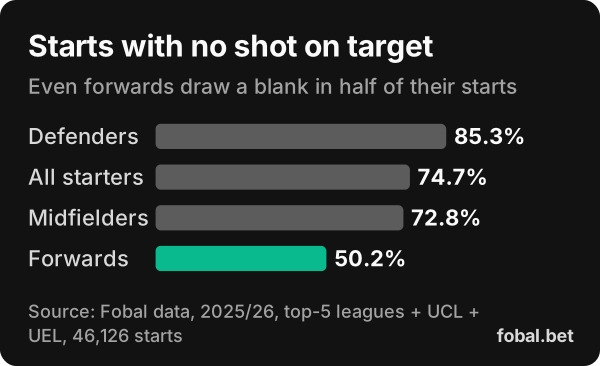
- 74.7% of starters record no shot on target in a match. Even forwards draw a blank 50.2% of the time, as the chart at the top of this page shows: a blank is the most common outcome for every position (Fobal data, 2025/26, seven competitions).
- A player who genuinely hits 60% of the time will show 8 or more hits in 10 matches about one time in six, by luck alone. Our analysis of why “8 of the last 10” hit rates mislead shows how much hot streaks cool off.
- Minutes are out of your hands. Only 34.2% of forwards’ starts last 90 minutes, as our guide to expected minutes in player props explains.
The healthy way to read your own analysis: it shifts the odds a little, and it never makes a bet safe.
Why do bet builders and longshot accumulators cost more?
Every price includes the bookmaker’s margin. On a single bet it is taken once. Combine legs and it compounds, and in a bet builder the bookmaker also decides how the legs relate to each other.
| Approx. margin | Bet type |
|---|---|
| 5% | Single bet, two-way market with a 5% margin (illustrative) |
| 18.5% | Four such legs combined in an accumulator (illustrative) |
| about 25% | Bet builder, 3 selections (UK sample) |
| about 35% | Bet builder including a player selection (UK sample) |
| about 40% | Bet builder, 4 selections (UK sample) |
The illustrative rows are arithmetic: four legs that each pay 5% below a fair price pay 0.95 × 0.95 × 0.95 × 0.95 = 81.5% of fair, so 18.5% less. The bet builder rows come from a Propus Partners analysis published by SBC News of UK bookmakers’ Premier League bet builders on 12–14 January 2024. The average margin ranged from 20% to 35% across bookmakers, and builders with player markets carried higher margins. The selection-count and player-market figures come from Gaming & Co’s write-up of the same study. It is one weekend’s sample, so read it as an order of magnitude, not a fixed rate.
None of this means you can never have a bet builder. It means a bet builder is closer to a lottery ticket than to an analytical bet: stake it as entertainment, at a fraction of your normal unit.
Responsible betting in practice: how should you set limits?
Decide everything before your first bet, while you are calm, and write it down.
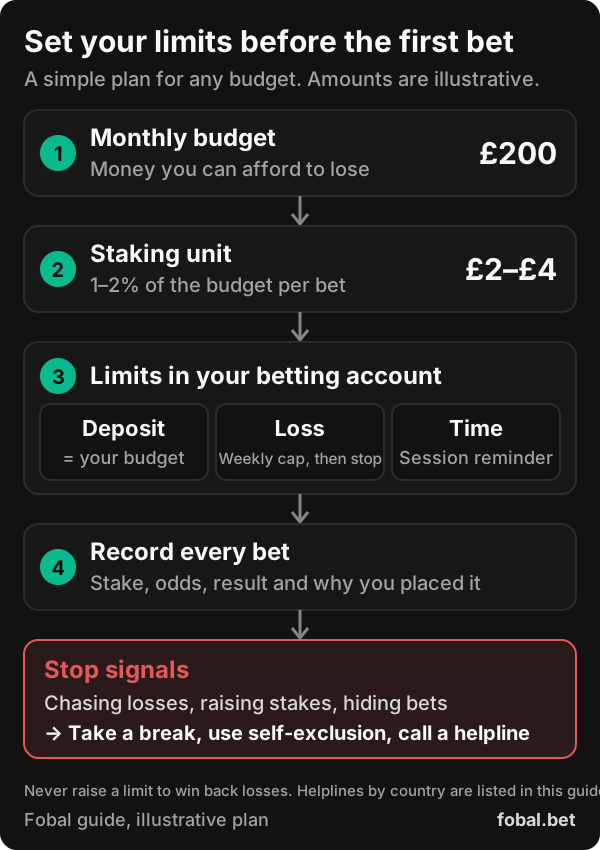
- Budget. Money you can afford to lose this month without it affecting bills, savings or your mood. Not money you hope to win back.
- Deposit limit = budget. Set it in your account so the plan holds on a bad night.
- Loss limit. A weekly cap. When you hit it, you stop until next week.
- Time limit. Session reminders or a daily cap. Betting during every match quietly becomes a habit.
- Never raise a limit to recover losses. If you want to raise one, wait a week and ask why.
Most licensed bookmakers offer deposit, loss and time limits and short time-outs in the account settings. Set them on day one.
What is a staking unit, and why use one?
A unit is the fixed amount you bet each time, set as a small share of your budget: 1–2% is a common choice. On a £200 monthly budget that is £2 to £4 a bet.
Flat stakes do two jobs. They stop a losing run from turning into bigger and bigger bets, and they make your results readable: 30 bets at one unit each tell you something, while a mix of £2 and £50 bets tells you only how you felt that day.
Keep a record of every bet: date, market, stake, odds, result and one line on why you placed it. Review it monthly. The record shows the truth that memory edits, and it is the simplest early-warning system there is.
| Habit | Healthy | Warning sign |
|---|---|---|
| Stakes | Same unit every bet | Bigger stakes after losses |
| Timing | Planned, before kick-off | In-play bets to “get it back” |
| Budget | Fixed monthly amount | Topping up mid-month |
| Records | Every bet logged | Avoiding the balance |
| Mood | Fun win or lose | Irritable, anxious, secretive |
What are the warning signs of a gambling problem?
The NHS lists signs that gambling is causing harm, including:
- betting more than you can afford to lose
- needing to bet more to get the same feeling
- chasing losses to win money back
- borrowing money or selling things to gamble
- stress, anxiety or other health problems linked to gambling
- people close to you criticising your gambling
- feeling guilty about how you gamble.
If several of these sound familiar, stop and talk to someone. The helplines below are free and confidential.
What tools can help?
- Account tools. Deposit, loss and time limits, time-outs and self-exclusion with a single bookmaker.
- United Kingdom: GAMSTOP. A free scheme that blocks access to gambling websites and apps licensed in Great Britain, for 6 months, 1 year or 5 years (NHS).
- Spain: RGIAJ. The DGOJ’s national exclusion register. Registration is indefinite, and you can ask to cancel it only after 6 months.
- Italy: Registro Unico Autoesclusi. ADM’s cross-operator self-exclusion blocks online gambling with every licensed operator. Request it on the ADM portal with SPID, or through an operator where you hold an account.
- France: interdiction volontaire de jeux. A voluntary ban run by the ANJ that covers authorised betting sites, for a minimum of three years, with no early lifting.
- Brazil. Fixed-odds betting is prohibited by Medida Provisória 1.394, of 25 September 2026 (Senado summary), which still needs approval by Congress. The federal self-exclusion platform is currently unavailable. For support, call CVV on 188.
Where can you get help?
| Country | Free helpline | Self-exclusion | Source |
|---|---|---|---|
| United Kingdom | 0808 8020 133: National Gambling Helpline (GamCare), 24/7 | GAMSTOP: 6 months, 1 or 5 years | NHS |
| Spain | 900 200 225: FEJAR | RGIAJ (DGOJ), indefinite | FEJAR, DGOJ |
| Italy | 800 558 822: Telefono Verde (Italian), Mon–Fri 10:00–16:00, anonymous | Registro Unico Autoesclusi (ADM) | ISS, ADM |
| France | 09 74 75 13 13: Joueurs Info Service, 7 days, 8am–11pm | ANJ voluntary ban, 3 years minimum | Joueurs Info Service, ANJ |
| Brazil | 188: CVV, 24h, emotional support | None at present: fixed-odds betting banned (MP 1.394/2026) | CVV, MP 1.394/2026 |
Helplines checked on 20 October 2026. If you are in immediate danger or thinking about harming yourself, contact your local emergency number.
How does Fobal fit in?
Fobal publishes information, not guarantees. Our hit rates, projections and picks are estimates built from past data, and every one of them can lose. We explain the method in how Fobal calculates hit rates so you can judge it for yourself, and we never tell anyone to bet more to recover losses. If you use our data, use it inside the limits you set, not as a reason to raise them.
Responsible betting checklist: before every session
- Is this money from this month’s budget? If not, stop.
- Are my deposit, loss and time limits set? Check them, don’t change them.
- Is each stake one unit? Bet builders and longshots: a fraction of a unit.
- Do I know how my bet settles? Read your bookmaker’s rules; our guide to how player props are settled covers the common cases.
- Am I betting to win back a loss? If yes, end the session.
- Have I logged the bet? Stake, odds, result and reason.
- Is it still fun? If not, take a break or use the tools above.
Frequently asked questions
What is responsible betting?
Betting only with money you can afford to lose, within limits you set in advance, for entertainment rather than income, and stopping when it stops being fun or starts causing harm. It includes using the limit and self-exclusion tools that licensed bookmakers and national schemes provide.
Why are bet builder margins higher than singles?
The bookmaker prices each combination of correlated selections itself, and its margin compounds across the legs. A January 2024 SBC News and Propus Partners sample of UK Premier League bet builders found average margins of 20–35%, higher with more selections and with player markets included.
What is a staking unit?
A fixed amount you bet each time, set as a small share of your betting budget, for example 1–2%. Flat stakes stop a losing run from turning into bigger and bigger bets.
How do I self-exclude from betting sites in the UK?
Register with GAMSTOP, a free service that blocks access to gambling websites and apps licensed in Great Britain for 6 months, 1 year or 5 years. You can also self-exclude directly with each bookmaker.
What are the warning signs of a gambling problem?
The NHS lists signs such as betting more than you can afford to lose, needing to bet more to get the same feeling, chasing losses, borrowing money or selling things to gamble, gambling-related stress or anxiety, and feeling guilty about how you gamble.
Where can I get help with gambling?
In the UK, call the National Gambling Helpline run by GamCare on 0808 8020 133, free and 24/7. In Spain, FEJAR on 900 200 225. In Italy, the Telefono Verde on 800 558 822. In France, Joueurs Info Service on 09 74 75 13 13. In Brazil, CVV on 188 for emotional support.